
Technical GuidesVimfun

Industrial Centrifuge Types and How to Choose

Choose an industrial centrifuge by the outputs the process needs: clarified liquid, two separated liquid phases, a transported sludge or a retained solids cake. Tubular bowl, disc stack, decanter and basket designs differ in the way they provide separation area and handle accumulated material, which makes the complete operating cycle central to selection.

How an industrial centrifuge separates the feed

Centrifuges create a rotating field in which materials behave according to density and the machine's internal arrangement. Some collect suspended solids from a liquid, some separate immiscible liquids, and some produce a more concentrated solids stream. These are different duties, and a single product does not necessarily perform all of them.

Describe the intended outputs before comparing equipment. Is the valuable product clarified coolant, a separated oil phase or a recoverable solids cake? What contamination is acceptable in each stream? The answer determines which trials and measurements are needed. A good-looking liquid sample may be insufficient if the solids cannot be discharged reliably.

An industrial liquid centrifugal separator enquiry should state the fluid, contamination and operating pattern in ordinary process terms. Include the existing tank and upstream handling. This avoids selecting a rotor first and trying to adapt the rest of the installation around it.

Tubular bowl

A tubular bowl centrifuge uses an elongated rotating bowl in which denser particles move toward a collection region. Fine-particle clarification follows the liquid viscosity, density difference and migration time as well as the rotating field.

Solids storage and removal distinguish practical options within this family. Vimfun's manufacturer data list 2 L solids collection capacity for the automatic VC-600 and 4.5 L for the manually cleaned VC-30P. The figures describe collecting space; automatic removal and a planned manual cleaning pause produce different operating tasks. Compare the entire isolation, cleaning, discharge and restart cycle with the plant's production window.

Sticky or compressible material also needs a workable exit. A clear-liquid result is only useful in production if the separated deposit can leave the bowl and be handled at the receiver. That is why the feed sample and solids-handling arrangement belong in the same discussion.
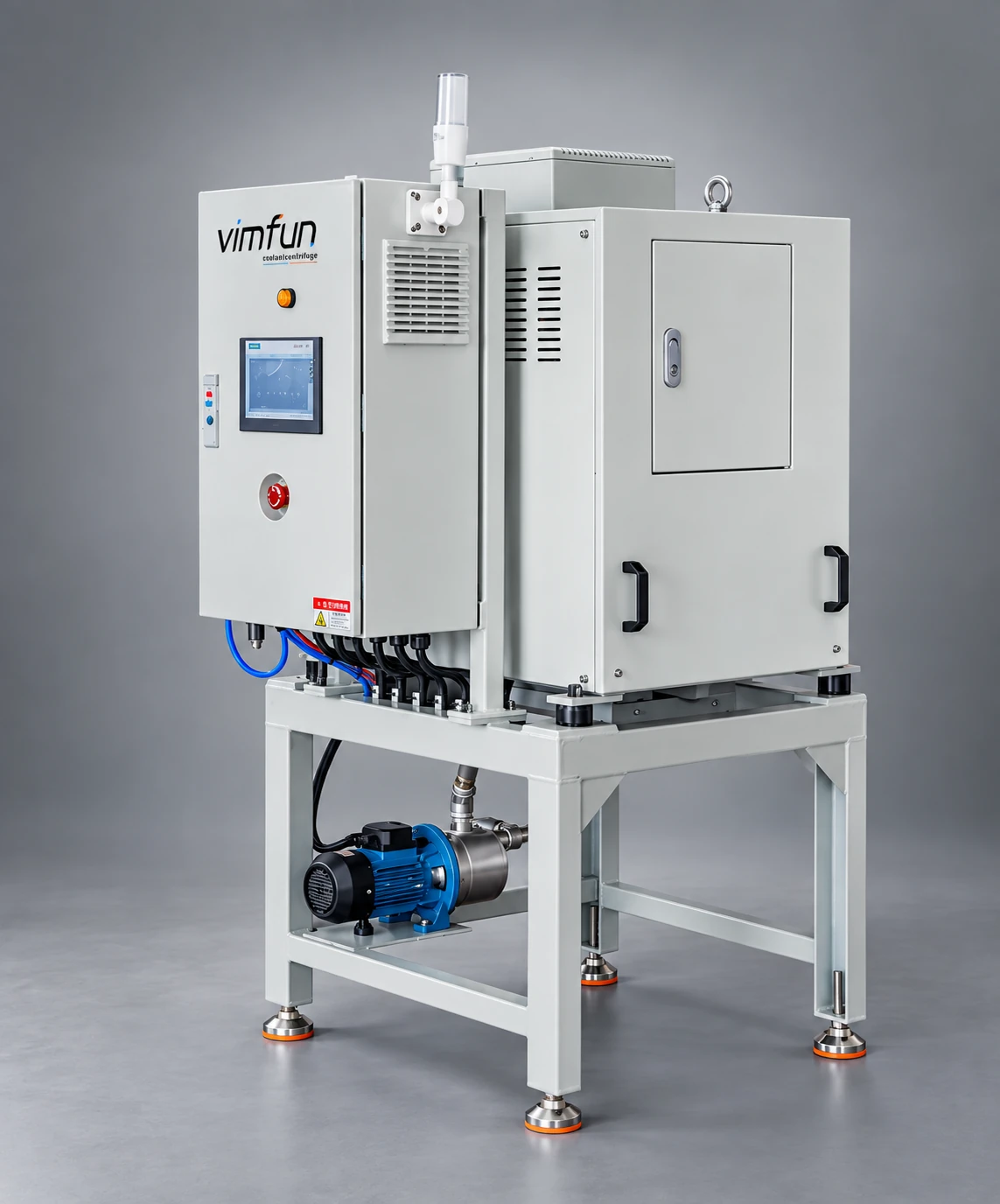
Vimfun VC-600 industrial coolant centrifuge.
Automatic centrifugal filtration in a semiconductor and photovoltaic application. Watch on YouTube

Disc stack

Closely spaced discs create short separating paths and a large effective area inside a compact rotating bowl. The outlet and interface arrangement determines whether the selected machine clarifies one liquid or separates two liquid phases while also collecting solids.

Changing feed composition, fouling and solids release affect the operating cycle. Compare those conditions with the proposed cleaning and discharge arrangement rather than treating a disc stack as a universal upgrade. A stable sample can be easy to clarify while an adhesive deposit still creates a substantial service task.

Decanter

A decanter typically has a rotating solid bowl and a scroll conveyor that moves separated solids toward discharge. The difference in rotational behavior between bowl and scroll enables transport of the accumulated material. This makes solids handling central to the design rather than an occasional manual bowl-cleaning task.

For a sludge duty, investigate both liquid clarification and the discharged solids condition. A visually acceptable liquid does not establish that the cake meets handling or recovery requirements. Feed variability, abrasive material and the properties of the deposit influence operation and wear.

The decanter is a candidate where continuous solids transport is useful, but its suitability still needs testing. Compare the required outputs, service access and downstream handling. Do not transfer a wastewater dewatering result to a coolant loop or assume a published capacity on another material describes the proposed grinding sludge.

Basket

A basket centrifuge retains solids in a rotating basket while separated liquid leaves through the design’s outlet path. Perforated baskets use filtration; imperforate baskets use sedimentation and may remove liquid by overflow or skimming. In filtering designs, a medium supports the solids and liquid passes through it. This is a different separation arrangement from a solid-bowl clarifier, where particles migrate through liquid toward the wall.

Basket equipment can be relevant when retaining and processing a solids product is the objective. Loading, washing where applicable, discharge and cycle time all affect the practical result. The characteristics of the cake and the medium are therefore part of the selection.

Do not specify a basket solely because the material is called sludge. Very fine or difficult-to-drain solids may need a different approach. Ask for a demonstration that includes cake release and the resulting liquid, then consider whether the batch or continuous workflow matches the upstream process.

Comparison table

Swipe horizontally to compare all columns.

DesignMain operating featureQuestions to settle in a trial
Tubular bowlSolids collect in a rotating clarification bowlActual clarification, accumulation and cleaning interval
Disc stackShort separating paths between discsPhase separation, fouling and discharge behavior
DecanterScroll transports solids through a solid bowlLiquid condition, cake consistency and stable solids conveyance
BasketBasket retains solids and allows liquid drainageMedium compatibility, drainage and cake release

Use the mechanism column to match the desired output, then compare how each design releases the material it collects. For example, a clarified-liquid duty still needs manageable sludge reception, while a cake-production duty also needs acceptable drainage and release. These destinations determine what the full operating cycle must deliver.

Compare utilities and maintenance on the same duty basis. Feed pumps, ancillary equipment and cleaning work belong in the evaluation alongside the centrifuge itself.

Choosing by solids load, particle size and flow

Describe the feed and the outputs in process terms. A coolant loop needs reusable liquid and a manageable sludge stream; a dewatering duty may place more emphasis on the solids; two immiscible liquids need identified outlets and interface control. Useful dispersed ingredients also need to stay identified so they are not mistaken for waste.

Flow values only make sense with their rating basis. Vimfun lists 960 L/h rated flow for the manual VC-30P, while 40 L/min is the automatic VC-600's recommended flow. These are different model and rating statements. Compare the actual duty and working fluid rather than reading them as a universal ranking of clarification or operating cost.

For machining-fluid centrifugal separation, higher feed reduces the time available in a given bowl, and higher viscosity resists particle movement. Those relationships explain why the desired output condition and treatment flow are discussed together.

In a coolant centrifuge loop, screened dirty liquid feeds the separator, clarified liquid returns to the working inventory and collected solids go to their receiver. Main machine supply may remain separate. A sample, working temperature and circulation sketch help Vimfun assess that solid-liquid arrangement; another industrial duty uses its own output and handling requirements.

Frequently asked questions

Which centrifuge type removes the finest particles?

There is no useful universal answer without the liquid, density difference, feed and required output. Ask for comparable results on the actual material under defined conditions.

Can a solid-liquid cleaner separate two liquids?

Only if the machine is designed and configured for that duty. Separate liquid outlets and phase control cannot be assumed from a solids-removal demonstration.

Should a sludge system prioritize dry solids?

Only when that is the process objective. Clarified liquid, manageable cake and reliable discharge may have different priorities. Define the acceptance criteria for every output.

Scroll to Top