
How Often Should You Clean a Coolant Sump?
Base the cleaning interval on measured fluid condition, deposits and the machine's operating history—not a universal calendar rule.
Review Your Sump Solids ProblemSet the Interval from Evidence
Coolant sump cleaning frequency should follow the fluid supplier's instructions, machine requirements and the site's condition records. There is no single interval that fits every water-mix system, neat-oil circuit or production schedule. Routine inspection, partial removal of accumulated debris and a complete drain-and-clean are also different jobs; they should not be grouped under one undifferentiated cleaning date.
A useful schedule states what is checked, what condition triggers action and who makes the decision. It should account for deterioration, deposits and the operational consequences of leaving contamination in place. Where a system repeatedly reaches the same unacceptable condition, review the cause instead of merely shortening the interval indefinitely.
This guide is for maintenance planning, not a substitute for the machine's cleaning procedure or a site-specific safety assessment. Water-mix fluid systems require particular attention to fluid hygiene and exposure controls. Neat oils need a different condition assessment, so do not apply the same test list without checking its relevance.
Separate Inspection, Intervention and Full Cleaning
An inspection may identify settled material, a change in fluid appearance, restricted return flow or a departure from the supplier's working limits. It provides information; it does not necessarily mean the entire charge must be discarded. Corrective action may instead concern a leak, a blocked collection point or a fluid-management error.
Targeted solids removal deals with accessible accumulation using an approved method. Full cleaning addresses the circuit more broadly, including deposits and locations that normal circulation does not reach. Simply pumping out liquid and refilling the same contaminated system may leave the original problem unresolved.
Record these activities separately. If a maintenance log says only cleaned, it is difficult to determine whether operators removed chips, changed fluid, treated a hygiene problem or cleaned the complete circuit. Clear records help the team understand why the next intervention became necessary.
Use Triggers That Match the System
| Observation | Next check | Planning implication |
|---|---|---|
| Increasing settled solids | Source, depth and effect on circulation | Review collection and fine-separation capacity |
| Fluid outside supplier limits | Confirm measurement and cause | Agree correction or replacement with the supplier |
| Recurring hygiene concern | Condition testing and inaccessible deposits | Review the full cleaning and fluid-management procedure |
| Restricted return or unstable delivery | Inspect collection points and pipework | Do not wait for an arbitrary cleaning date |
| Long shutdown or process change | Restart requirements and compatibility | Plan a specific inspection before reuse |
The thresholds belong in the site's procedure, based on the actual fluid and process. Avoid copying a cleaning interval from another factory without knowing its materials, shifts, sump geometry and monitoring practice. Similar tank volumes can have very different maintenance needs.
Build a Maintenance Record Operators Can Use
Start with the sump identifier, fluid product, working volume and machines served. Add the inspection date, relevant measurements, deposits observed and any action taken. Record significant top-ups, leaks, product changes and production interruptions so that unusual results can be interpreted in context.
Keep the form short enough to be used consistently. A practical log is more valuable than a detailed template that is completed only after a problem. Use the same inspection points where possible and note when access or machine operation prevents a normal observation.
Review trends with the maintenance and production teams. If a particular material or operation is followed by rapid solids buildup, investigate that source. If a clean-and-refill is followed by recurring poor condition, examine the cleaning scope and fluid preparation rather than assuming the original charge was simply too old.
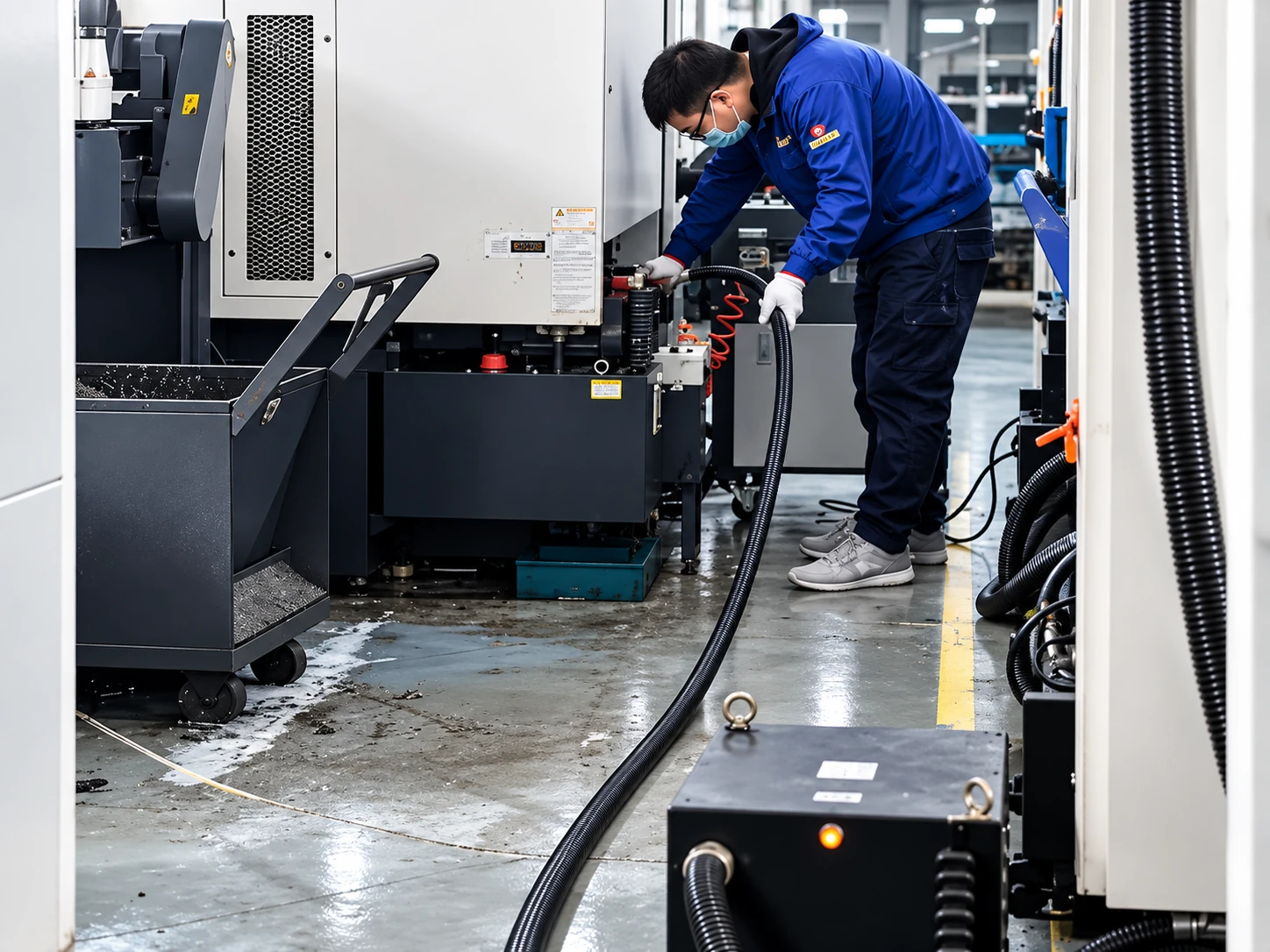
Plan Safe Access before the Shutdown
Cleaning can involve contact with contaminated fluid, moving machinery and difficult access. Use the site's isolation, handling and waste procedures. Do not enter a sump or tank as an informal cleaning shortcut; access and any potential confined-space work require competent assessment and appropriate controls.
For water-mix systems, the UK HSE's sump-cleaning guidance addresses exposure during cleaning. Its guidance is a useful reference for planning, while the applicable local requirements and site assessment determine the work method. Avoid uncontrolled spraying or other methods that create unnecessary exposure.
Schedule sufficient time for the approved sequence, checks and restart. Provide the required collection equipment and waste route before draining starts. A rushed changeover can leave the team improvising around inaccessible deposits, unsuitable containers or unavailable replacement fluid.
Where Filtration Can Reduce the Cleaning Burden
Effective chip collection and fine-solids separation can reduce the material available to settle in the sump. That may help address a solids-driven maintenance problem, but it does not remove all causes of fluid deterioration. A centrifuge should not be presented as a disinfecting system or a replacement for necessary cleaning.
Assess the fines-removal duty if deposits are the main trigger. Check whether the proposed feed point actually reaches the contaminated inventory. A loop that continually treats a clean corner can leave the accumulation problem elsewhere in the sump largely unchanged.
El fluid-life guide provides the wider maintenance context. To judge a filtration change, compare cleaning work and deposit accumulation over representative production periods. Do not assume a longer interval until the records support it and the fluid still meets its operating requirements.
Review the Interval after Changes
An established schedule should be reconsidered when machine loading, materials, fluid products or shift patterns change. A new separator may alter solids accumulation, while a new process can increase it. Both are reasons to update the evidence, not to remove inspection from the routine.
Ask whether the original trigger has become less frequent, whether another problem now controls the interval and whether the work remains safe and practical. Record the reason for any extension so that future operators understand the basis rather than inheriting an unexplained date on a calendar.
If smell is the immediate concern, use why coolant smells as a diagnostic starting point. Odour is a reason to investigate, not an independent measure of fluid safety or a reliable replacement for condition testing.
Review Your Sump Solids Problem
If settled fines are driving frequent cleaning, send the sump volume, machine duty, contamination description and cleaning history. We can assess the role of solids separation.
Send Application Details