
Demander un devis
Guides techniquesVimfun

Comment fonctionne une centrifugeuse à bol tubulaire

A tubular bowl centrifuge spins a liquid in an elongated bowl so denser suspended particles migrate outward and collect away from the clarified-liquid outlet. Its useful operating capacity comes from the combination of acceleration, separation time and solids storage or discharge, rather than rotor speed alone.

The tubular bowl centrifuge design

The bowl contains the rotating liquid and provides a region where particles can move toward the outer wall. Feed enters through a controlled path, accelerates with the liquid and leaves through the outlet arrangement. Solids that reach the collection zone remain there until the machine's discharge or cleaning procedure removes them.

The term tubular centrifuge describes a bowl family, not one universal construction. Commercial designs differ in orientation, outlets, solids capacity and drive arrangement. Some are intended mainly for clarification; other centrifugal designs can manage different liquid phases. Obtain a section drawing of the proposed machine rather than assuming that a diagram found under the same search term describes its internals.

Trace the liquid from inlet to outlet on that drawing. Identify where solids collect, how the feed is protected from large debris and what prevents a startup or shutdown condition from sending untreated liquid to the process. This review often exposes installation requirements that a simple motor-power comparison would miss, including feed control and safe drainage.

Why it reaches high G-force

Centrifugal acceleration rises with rotational speed and the distance from the axis. Consequently, rpm alone is not a complete specification: the radius at which the acceleration is stated matters as well. The centrifugal force G value expresses acceleration relative to gravity, not a particle-removal guarantee.

Vimfun's manufacturer specification lists the VC-600 at 8,000 rpm and 6,500 G. These manufacturer specifications describe the rotating field; particle properties, working viscosity and feed rate complete the separation duty. Use the same model and speed configuration when comparing an operating proposal with the published data.

Separation also needs time. A particle must migrate far enough before the liquid leaves the bowl. Feed rate, viscosity and particle density therefore affect the result alongside acceleration. A demonstration should state the fluid temperature and treatment flow, and use samples taken during stable operation. This makes the result usable when deciding whether the centrifuge principle suits the plant's duty.

How solids collect and are discharged

Particles that reach the collection region occupy bowl space until the cleaning or discharge sequence removes them. More solids entering per unit of liquid shorten the accumulation interval. A sticky deposit can instead extend the removal task even when its mass is modest. These are different reasons for an inconvenient service cycle.

Observe the deposit through a complete run. Free-draining metal fines, oil-rich sludge and glass residue can release differently, changing the work required at the receiver. The feed condition, running interval and handling time show whether the arrangement fits the plant's operating window.

Cleaning follows the machine's stopping and isolation procedure before rotating parts are accessed. The receiver and any lifting or removal space belong on the layout from the start. A machine that clarifies well but cannot be serviced easily will still interrupt the process.
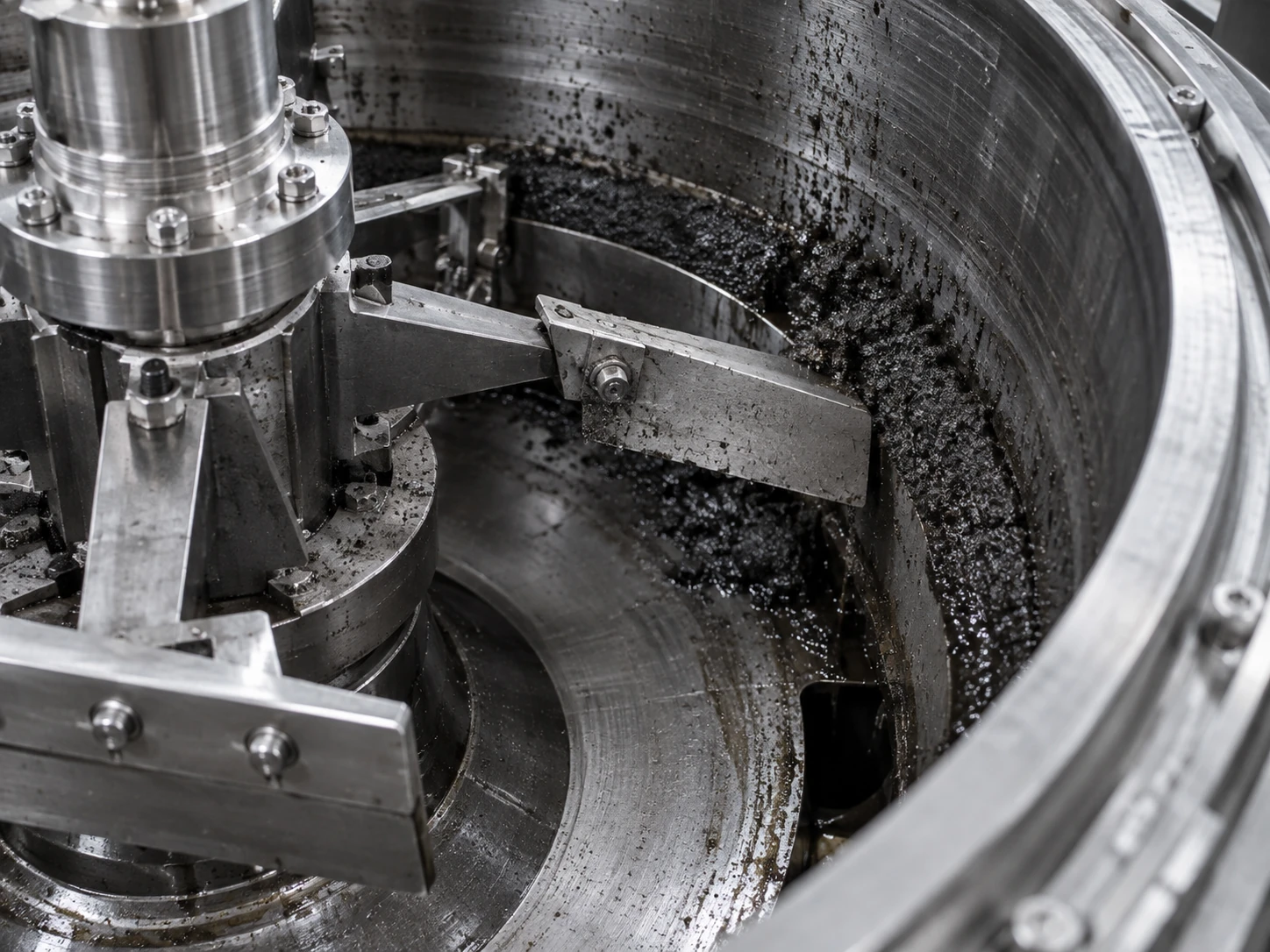
Interior view of an automatic centrifuge bowl and sludge scraper assembly.
Automatic centrifugal solids discharge in a semiconductor and photovoltaic fluid application. Regarder sur YouTube

Manual vs automatic discharge

A Le séparateur centrifuge à décharge manuelle suits a duty that can accommodate an operator-led cleaning pause. Vimfun's VC-30P manufacturer data list 4.5 L solids collection capacity. That space helps plan accumulation, but service time also includes isolation, opening, cleaning, inspection and restart.

Le vaut la peine d'être évaluée lorsque des éliminations répétées de solides interrompraient autrement la routine d'exploitation. La décharge automatique nécessite toujours un conteneur de collecte approprié, des vérifications et une maintenance. La consistance du matériau collecté affecte la manipulation, alors ne promettez pas de déchets secs et fluides à partir d'un liquide non testé. changes the removal task to its designed sequence plus receiver handling. The VC-600 is listed with 2 L solids collection capacity. A smaller collecting space with an automatic cycle and a larger manually cleaned space create different work patterns; bowl volume alone does not rank their operating convenience.

For either arrangement, trace the feed during discharge, the solids path to the receiver and how an incomplete cycle is indicated. Those details decide whether a cleaning pause fits production or the process needs another supply arrangement while the unit is being serviced. Automatic discharge still leaves inspection and receiver changes to plan.

What it suits and what it does not

Tubular-bowl clarification is a candidate when the contamination is separable by density and the liquid remains suitable after solids removal. Low or moderate suspended load may be manageable with an appropriate discharge plan. The correct envelope is machine-specific; broad labels such as fine particles or high speed cannot replace a sample trial.

It is a poor assumption that centrifugal clarification will remove dissolved salts, restore degraded additives or solve every emulsion problem. Those are different treatment objectives. High solids throughput may also point toward a different bowl and discharge design. In a disc stack vs tubular bowl assessment, compare the required phases and service tasks before looking for a headline efficiency figure.

Test conditions should represent the liquid the machine will receive. Settling in a stored sample changes the suspended population, warming an oil changes viscosity, and a short run may miss the buildup that governs cleaning. A representative feed and a complete collection cycle let the trial address both clarification and service work.

Tubular bowl centrifuges for coolant and oil

A centrifugeuses pour liquide de refroidissement à base d'eau is normally integrated with a tank and feed arrangement rather than considered as an isolated bowl. Coarse chip handling, fluid levels and the supply-pump route all influence the installation. A separate cleaning loop can keep its flow independent of the machining circuit, provided its suction and return positions reach the contaminated liquid effectively.

For neat oil, use viscosity at the intended temperature, not a water-based demonstration, when discussing capacity. For water-mix coolant, confirm that the formulation's useful properties remain acceptable after treatment. In both cases, assess the separated sludge and the liquid carried out with it, since that determines the handling task and material balance.

A useful enquiry includes the fluid identity, temperature, contamination sample, reservoir layout and operating pattern. Add the required supply condition and a practical definition of successful cleaning. With these inputs, Vimfun can assess a bowl, feed and discharge arrangement for the stated process. A speed value alone cannot provide that basis.

Foire aux questions

Is higher rpm always better?

Compare acceleration at the stated radius, the liquid viscosity and the separation time together. The operating point that gives acceptable clarification and a practical solids cycle is more useful than speed by itself.

Can a manually cleaned unit treat fluid continuously?

It treats fluid between required cleaning stops. Include isolation, cleaning, inspection and restart in the operating plan, with another supply arrangement if the process cannot pause.

What maintenance remains with automatic discharge?

The bowl, drive, discharge mechanism and receiver still need service. Use the documented sequence to assign inspection, receiver handling and the response to an interrupted cycle.

Défiler vers le haut