
Troubleshooting Guide · D8

Why Does Coolant Smell Bad?

An unusual smell is a reason to investigate fluid condition—not proof that a filter, additive or complete fluid change is the right answer.

Review Your Coolant Contamination

Start with the Fluid, Not an Odour Remedy

Why does coolant smell bad? In a water-mix metalworking fluid system, unusual odour can accompany poor fluid condition, microbial activity, unwanted contamination or stagnant areas. Smell alone cannot identify the cause or establish whether the fluid is safe to use. Confirm the fluid type, check its condition and investigate changes in the circuit before choosing a corrective action.

This guide concerns machine-tool fluids, not vehicle engine coolant. Neat cutting oils and water-mix coolants also require different assessments. A strong smell after a process change may have a different explanation from a recurring odour after a shutdown. Do not assume all cases are bacterial or that every dark fluid needs replacement.

If workers report irritation, breathing symptoms or another exposure concern, follow the site's reporting and safety procedures promptly. Equipment selection is not the first response to a possible health issue. The responsible team should assess the workplace conditions and obtain appropriate professional advice.

1. Confirm What Changed

Record when the odour was first noticed and whether it affects one machine or several. Note recent top-ups, fluid changes, leaks, production materials and shutdowns. Ask whether the smell is strongest near a return, an enclosed sump or a separate waste container. This helps distinguish a circuit problem from a nearby source.

Identify the actual product in the sump and how it was prepared. A label on an old container or a general description such as soluble oil may not be enough. If the plant uses several fluids, check whether a transfer, top-up or machine connection could have introduced an incompatible product.

Avoid asking operators to deliberately smell samples at close range. Describe observations already noticed during normal work and use the site's safe sampling procedure for further investigation. A sensible diagnostic record should reduce unnecessary exposure, not create a new informal test around it.

2. Check Fluid Condition with the Supplier's Methods

For water-mix fluids, use the supplier's specified checks and working limits. Concentration, relevant chemical condition and microbiological monitoring may each provide different information. A single reading does not describe the entire fluid, and an apparently normal concentration does not rule out another problem.

The UK HSE's fluid-quality guidance emphasises managing fluid condition and avoiding stagnation. Use it as a reference alongside the fluid supplier's instructions and local requirements. Do not rely on smell or appearance as the sole basis for a hygiene decision.

Record the method, result and sampling location. Repeating a measurement consistently is more useful than comparing unrelated samples taken from different corners at different operating conditions. If a result is outside the agreed limits, ask the supplier or responsible specialist to interpret it before adding corrective chemicals.

3. Investigate Leaks, Deposits and Poor Circulation

Unwanted oil, accumulated chips and poorly circulated areas can make fluid management more difficult. Inspect machine leaks, collection points, return routes and locations that remain stagnant. Repairing a source of contamination may be more effective than repeatedly treating the symptom at the sump surface.

A recurring issue after weekends or shutdowns deserves a review of the operating and restart routine. Do not improvise continuous pumping or aeration without checking machine requirements and exposure controls. The appropriate circulation arrangement depends on the equipment and fluid-management plan.
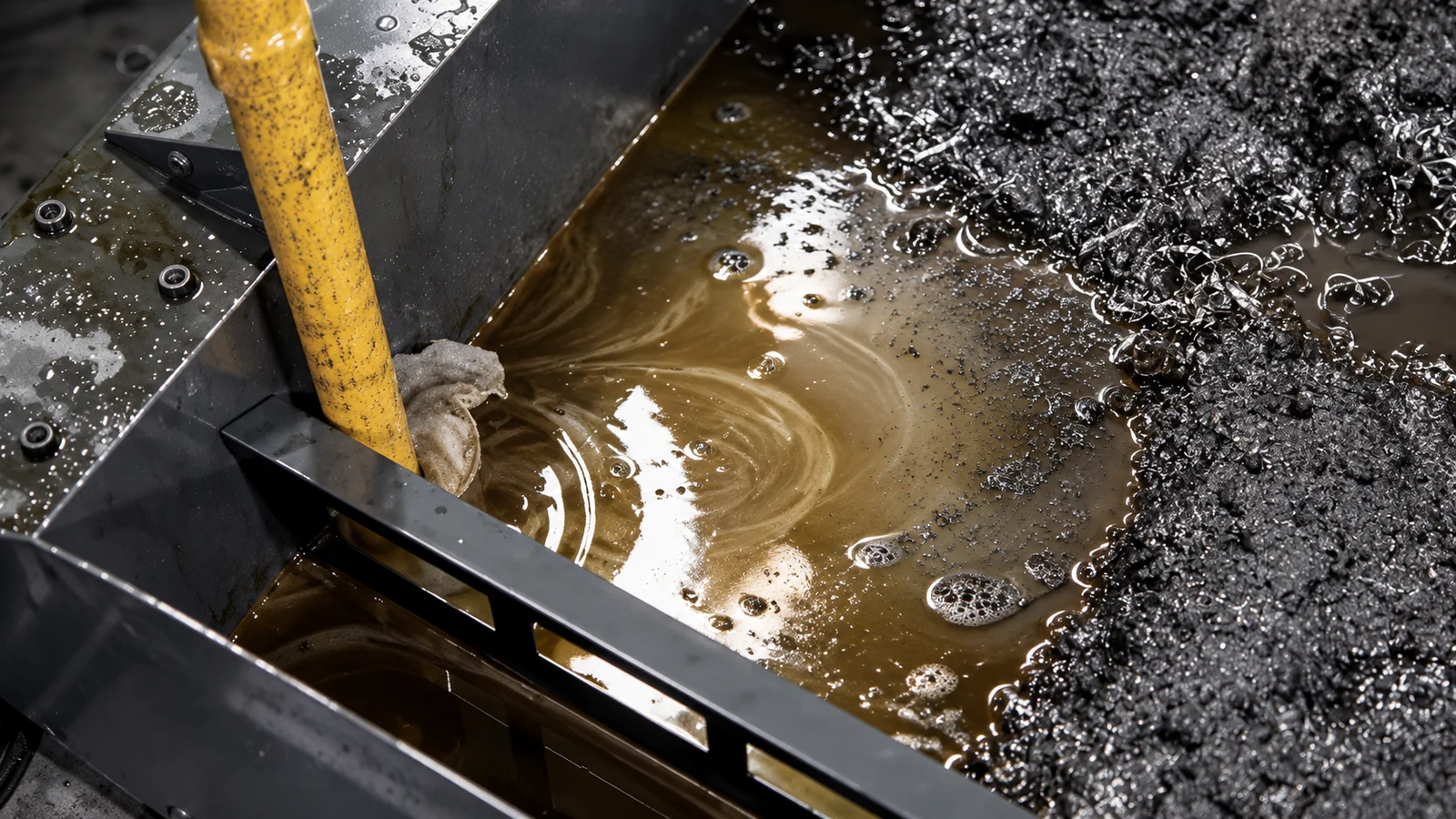
工業用クーラントサンプに蓄積した金属切りくずと暗いスラッジ
Observations that help the investigation
ObservationQuestion to resolve
One machine affectedIs there a local leak, deposit or return-flow problem?
Several machines affectedIs the common fluid supply or preparation method involved?
Issue follows shutdownDoes the storage or restart routine need review?
Issue follows a top-upWas the correct product and preparation method used?
Rapid recurrence after cleaningWas the source corrected and the full circuit addressed?

4. Choose Correction or Cleaning from the Evidence

The next action may involve correcting fluid preparation, repairing a leak, improving collection, or following an approved drain-and-clean procedure. Which route is appropriate depends on the confirmed problem and the condition of the fluid. Adding fresh fluid to a contaminated system is not automatically a lasting correction.

Do not use fragrances, household cleaners or an improvised biocide dose to hide the smell. Any chemical treatment must be compatible with the fluid and follow the supplier's instructions and applicable safety requirements. This page does not specify a chemical dose because that decision cannot be made from an odour description.

If full cleaning is required, plan it as a controlled maintenance task. Review coolant sump cleaning frequency for the distinction between inspection, targeted debris removal and complete cleaning. Record what was actually done so that recurrence can be investigated rather than treated as a new unexplained incident.

5. Prevent Recurrence without Overpromising Filtration

Maintain the agreed fluid checks, investigate leaks and keep chip collection working. Assign responsibility for reviewing the log rather than relying on a complaint when the smell becomes noticeable. After corrective action, check whether the original condition remains controlled during normal production and after the next relevant shutdown.

A centrifuge can address suitable suspended fines and some sludge-forming material. It is not a steriliser and should not be specified as a guaranteed cure for coolant odour. If the investigation identifies a solids burden, クーラントからの微粉除去 can be evaluated as one supporting measure.

For the wider routine, see how to extend cutting fluid life. A practical prevention plan links fluid preparation, machine condition, housekeeping and treatment. Purchasing a separator does not transfer all of those responsibilities to the equipment.

Questions to Ask before Restarting Normal Use

Has the cause been identified, or has only the smell changed? Are the relevant measurements back within the agreed operating limits? Have leaks, stagnant sections or cleaning omissions been addressed? These questions are more useful than asking whether the liquid now looks fresh.

Document the action and the follow-up date. If the problem returns, retain the earlier results and discuss them with the fluid supplier and responsible site personnel. Repeatedly changing products or adding treatments without a record makes the root cause harder to identify.

Where the remaining issue is solids accumulation, an application review can establish whether separation is suitable. Where chemistry, microbial control or exposure remains unresolved, continue with the appropriate specialist assessment rather than treating equipment installation as proof that the concern has been removed.

Review Your Coolant Contamination

For a fines or sludge problem, send your fluid type, machine duty and sump history. For fluid chemistry or hygiene concerns, involve your fluid supplier and site safety team.

Send Application Details
上部へスクロール