
Technical GuidesVimfun

Quench Oil Maintenance: Tests, Sludge and Oil Life

Quench oil maintenance combines cooling-behaviour testing, control of water ingress and removal of scale or sludge from the circulating oil. Keep the fluid assessment linked to the heat-treatment process: solids cleaning addresses a contamination load, while cooling-curve and oil-condition results guide decisions about the quenchant itself.

What quench oil maintenance must track

Quench oil experiences thermal exposure, contact with workpieces and contamination entering the tank. Oxidation and thermal degradation can alter its condition, while water, scale and carryover from upstream operations introduce separate problems. A dark appearance may accompany service, but color alone does not identify the mechanism or decide whether a charge should be replaced.

Record the oil grade and additions so laboratory results can be compared against an appropriate reference. Mixing a different quenchant into the tank can change cooling behavior independently of sludge. An undocumented top-up also makes trends difficult to interpret. Keep a retained sample or supplier reference for the oil actually specified.

Investigate process changes alongside oil changes. Loading, agitation, tank temperature and workpiece condition can affect heat transfer and finished-part results. An abnormal hardness or distortion result is a reason to examine the whole quenching operation, not proof that filtration has failed. Quench oil life should be judged against defined condition and process criteria rather than an arbitrary calendar age.

Tests that matter: cooling curve, water, sludge

Cooling-curve testing measures how the quenchant removes heat under a defined procedure. Oil-condition analyses help explain why that behaviour changes. The oil supplier or qualified laboratory selects the tests and comparison limits for the product and heat-treatment process.

Water and insoluble material need separate observations. Suspected water ingress calls for source identification and the qualified plant response, not simply heating or running a solids cleaner. Sludge testing describes a particulate burden that may be addressed by source control and cleaning. A change in one result does not settle the other question.

Use a repeatable circulating sample point and the laboratory's handling method, then place the results beside oil additions, production changes and maintenance dates. This single history connects an abnormal result to an event. It also avoids the common habit of treating every dark charge or unusual hardness result as a reason to increase filtration.

Where sludge comes from

Sludge can include degradation products and material introduced with the work. Scale and other residues may collect in the tank or remain suspended depending on size, density and circulation. A sample taken near the surface can miss deposits on the floor, while sampling immediately after a disturbance can temporarily exaggerate the usual circulating load.

Locate the accumulation before deciding how to remove it. Inspect accessible return zones, screens and the tank's low points under the plant's safe maintenance procedure. Check whether agitation reaches the whole tank and whether deposits can be removed without uncontrolled disturbance. A cleaning loop that draws only from a clear upper zone may leave the main deposit untouched.

The focused guide to quench oil sludge problems addresses solids troubleshooting. For overall maintenance, the key is to connect sludge observations with the testing history and contamination sources. Remove the cause where practical, such as workpiece carryover or a failing component, as well as collecting the accumulated material. Otherwise the cleaner may repeatedly handle an avoidable load.

Cleaning oil at working temperature

A cleaning loop operating at the intended oil temperature can avoid making cooling and reheating part of every treatment cycle. Selection still covers the whole hot-oil path: feed pump, seals, piping, bowl, drains and receiver.

For a high temperature oil centrifuge discussion, the VC-30T manual model has a manufacturer-listed 0–110 °C operating-temperature range and 960 L/h rated flow. The temperature range helps identify a candidate; the flow must also be considered at the actual quench-oil viscosity. These are this model's figures, not a high-temperature claim for the automatic range.

A centrifugal oil cleaner collects particles with a suitable density difference from the oil. Dirty oil enters from a meaningful circulating point after coarse protection, clarified oil returns to the tank, and the collected scale or sludge leaves through the documented cleaning route. A pickup confined to clear upper oil may miss the material causing the maintenance problem.

Quench oil filtration therefore combines the solid-liquid duty with safe hot-oil access and the plant's process checks. The sample before treatment, treated stream and relevant quenchant-condition results show which change came from solids cleaning. Oil chemistry and cooling behaviour remain the heat-treatment team's acceptance questions.
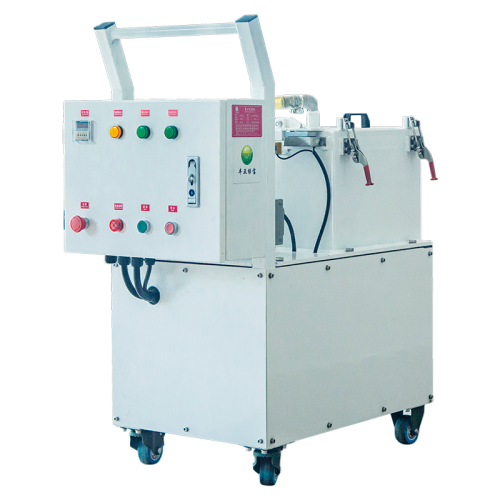
Manual-discharge industrial oil centrifuge from the existing product library.

A simple maintenance schedule

Separate routine observation from laboratory checks and corrective work. Operators can report level changes, leaks, changed circulation or deposits; maintenance can examine the fluid path and cleaner; the heat-treatment or quality team decides whether the oil and process remain acceptable. The fluid supplier or laboratory interprets the oil tests.

The schedule follows the operating pattern and supplier instructions, with an earlier check after suspected water ingress, an unusual addition or an unexplained process deviation. Put those events beside the next result rather than waiting for a routine test date. A consistent tank and oil-charge identity makes that history usable.

For the cleaner, include coarse protection, feed condition, the collection cycle and receiver handling. A completed repair should be followed by an observation or sample showing what changed. The resulting decision can then be specific: continue monitoring, correct a contamination source, remove accumulated solids or replace the charge under the approved procedure.

Vimfun centrifuge operating on cold heading oil. Related oil-treatment demonstration. Watch on YouTube

Frequently asked questions

Can clear quench oil have unsuitable cooling behaviour?

Yes. Use the specified cooling-curve and oil-condition tests to assess the quenchant, and review loading, agitation and temperature with the heat-treatment team.

Will a solids centrifuge remove water?

Water requires a separately assessed treatment and response. After suspected ingress, identify the source and follow the qualified oil and heat-treatment procedure rather than treating solids cleaning as the correction.

Should oil be changed whenever sludge appears?

Base the decision on the oil condition and process requirement. Cleaning may address the solids burden when the charge remains usable; other deterioration may require replacement under the approved procedure.

Scroll to Top