
An oil centrifuge uses rotation to separate particles or liquid phases according to their density difference from the oil. For cutting and forming oils, start by choosing between solids clarification and liquid-liquid purification; engine bypass cleaners, industrial solids cleaners and disc stack purifiers have different feed, outlet and maintenance arrangements.
What an oil centrifuge does
In a rotating bowl, components with different densities tend to move to different radial positions. A solid-liquid cleaner collects denser particles away from the clarified oil path. A machine built for liquid-liquid separation additionally manages distinct liquid outlets or interfaces. These are different capabilities, even when both products are described as an oil cleaning centrifuge.
The useful question is what must leave the oil. Suspended metal fines, free water and dissolved contamination require different evaluation. A unit demonstrated on dense particles is not thereby proven to remove an emulsified liquid or dissolved degradation products. The condition of the oil after treatment must still meet its application's requirements.
Review the complete operating cycle, including startup, normal feed, shutdown and solids removal. The available separation time changes with feed rate, while viscosity changes with temperature. Manufacturer capacity should be tied to a defined liquid and duty. For a used-oil sample with an unknown history, identify the oil and contaminants first; visual clarification alone cannot establish that it is fit for reuse.
Engine bypass centrifuges
An engine bypass cleaner treats part of the lubricating oil outside the main full-flow protection path. Some designs use engine-oil pressure to drive the rotor, so available pressure and the return arrangement are essential parts of the installation.
That branch must preserve the engine's required lubrication supply. Its service and return conditions come from the engine and cleaner instructions. A free-standing industrial oil tank instead needs a feed arrangement chosen for its working liquid and contamination load. The different drive and return functions are the reason these units are not interchangeable simply because both rotate oil.
Industrial oil cleaners for cutting and forming oils
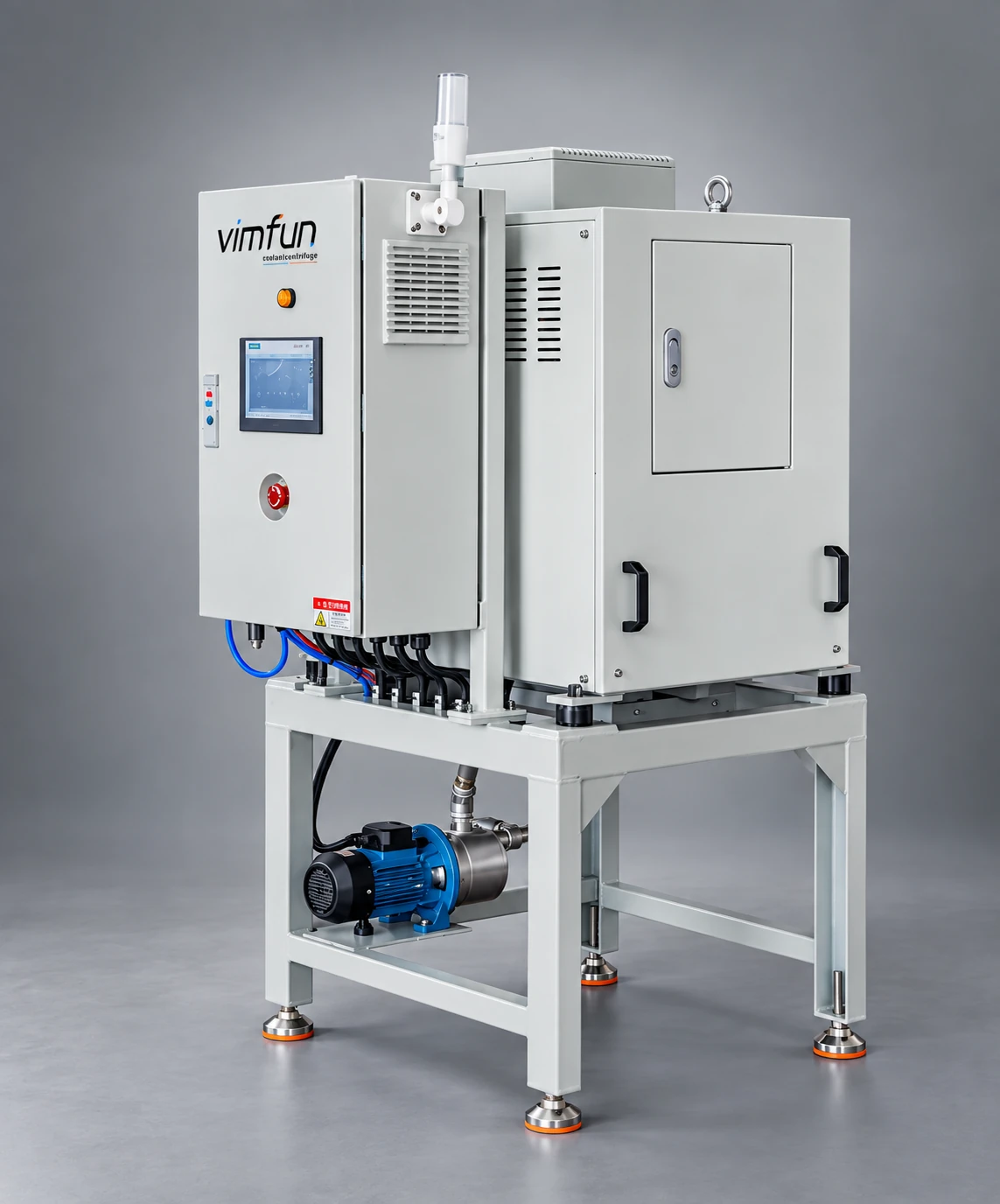
Cutting and forming oils carry metal fines and process residues that can accumulate in the reservoir or load disposable elements. A centrifugal oil cleaner collects denser solids at the bowl wall while clarified oil leaves along its liquid outlet. In an independent loop, the dirty pickup reaches the contaminated tank region after coarse protection; treated oil returns to the inventory and collected sludge has its own receiver.
For this solids-cleaning duty, Vimfun's VC-600 manufacturer specification lists a recommended flow of 40 L/min. The actual operating point follows working viscosity and the particles being collected. A small, slowly settling fraction needs more migration time than a coarser feed, so flow and clarification are considered together.
Hot oil adds a second selection question. The VC-30T manual model is listed with a 0–110 °C operating-temperature range, while the automatic VC-600 is listed at 0–80 °C. These model limits help narrow the enquiry for a high temperature oil centrifuge; the pump, seals, piping and receiver must also suit the intended oil and temperature. Heating oil only to improve a headline flow is not a substitute for selecting the complete duty.
Disc stack oil purifiers
A disc stack purifier contains many closely spaced discs inside a rotating bowl. Their arrangement provides short separation paths and substantial separating area within a compact volume. Depending on configuration, this type can clarify a liquid or separate liquid phases while also collecting solids. A purifier designation does not describe every disc stack product's exact outlets or operating mode.
The feed condition remains important. Stable emulsions are different from readily separable free water, and a machine's water-handling capability must be confirmed for the oil in question. Ask how the interface is controlled, how solids are discharged and what happens when feed composition changes. These details can matter more than a broad claim of high centrifugal force.
A disc stack vs tubular bowl comparison should cover service access, solids storage, cleaning needs and the intended phase separation. The disc stack may offer a different operating envelope, but it is not automatically the right upgrade for every oily sump. A representative test and a clearly described feed stream make the comparison useful.
Comparison table
Swipe horizontally to compare all columns.
| Type | Main selection question | Installation issue | Boundary to confirm |
|---|---|---|---|
| Engine bypass cleaner | Is it approved for the engine circuit and contamination? | Available oil pressure and correct return | Does not replace required full-flow engine protection |
| Industrial solids cleaner | Can it remove the actual process fines at working viscosity? | Tank circulation and sludge collection | Liquid-liquid separation must be separately documented |
| Disc stack purifier | Which liquid phases and solids must be separated? | Feed conditioning and outlet/interface control | Emulsion behavior and solids discharge need validation |
Compare units within the same separation duty. Similar motor power can drive different separation areas, solids capacities and discharge mechanisms. Calculate service work over the intended operating period, including access, receiver changes and the interruption for bowl cleaning, so purchase price is considered alongside the operating task.
Include the resulting waste in the comparison. Oil retained in sludge, cleaning materials and replacement parts all affect operation. A media-free oil centrifuge machine still produces a concentrated contaminant stream and needs inspection. Request the proposed maintenance sequence so the plant can judge whether it fits staffing and access.
The outlet arrangement keeps the shortlist focused. A solids cleaner needs a clarified-oil path and practical sludge handling; a water-separation duty needs the appropriate liquid outlets and interface control as well. Compare speed, power and service effort within the family that provides those functions.
Choosing an oil centrifuge for industrial use
An oil sample and a short duty description make the selection concrete: oil identity, working temperature, contamination source, required flow and the process problem. Add the tank layout, running pattern and coarse protection. If water is present, identify whether it is a free phase or an emulsion before choosing the phase-separation arrangement.
Agree on an acceptance method that follows the process. Measure the relevant contamination before and after treatment under consistent sampling conditions, then confirm the oil remains suitable for service. Where the goal is fewer blocked nozzles or less tank sediment, track those outcomes rather than relying on the appearance of a sample jar.
Finally, walk through access, containment, isolation and restart. Decide who inspects the bowl, where sludge goes and how a failed cleaning loop is detected. This turns a broad equipment search into a practical selection. Industrial oil cleaning needs a matched circuit and a service plan as well as a separator.
Frequently asked questions
Will an oil centrifuge remove water?
A liquid-liquid configuration can address suitable separable water with the correct outlet and interface arrangement. For solids-only equipment, specify water handling separately and assess whether the unwanted water is free or emulsified.
What does clearer treated oil indicate?
It can indicate a visible reduction in suspended contamination. Compare the relevant solids measurement and oil-condition results to decide whether the treated oil remains suitable for its process.
Can an engine bypass cleaner serve an industrial tank?
Its drive and return requirements may differ. Select the industrial feed, fluid and discharge duty first, then assess a unit with a documented arrangement for that circuit.
