
Recover liquid from the specified feed
Confirm the vapour-feed composition, flow units and process connection for the selected configuration. Liquid output uses a diaphragm-pump arrangement. Review liquid-feed distillation requirements separately.
A solvent-recovery product line with 50, 100 and 150 L storage-tank options. Review the solvent stream, vapour feed and recovered-liquid requirements before selecting a configuration.
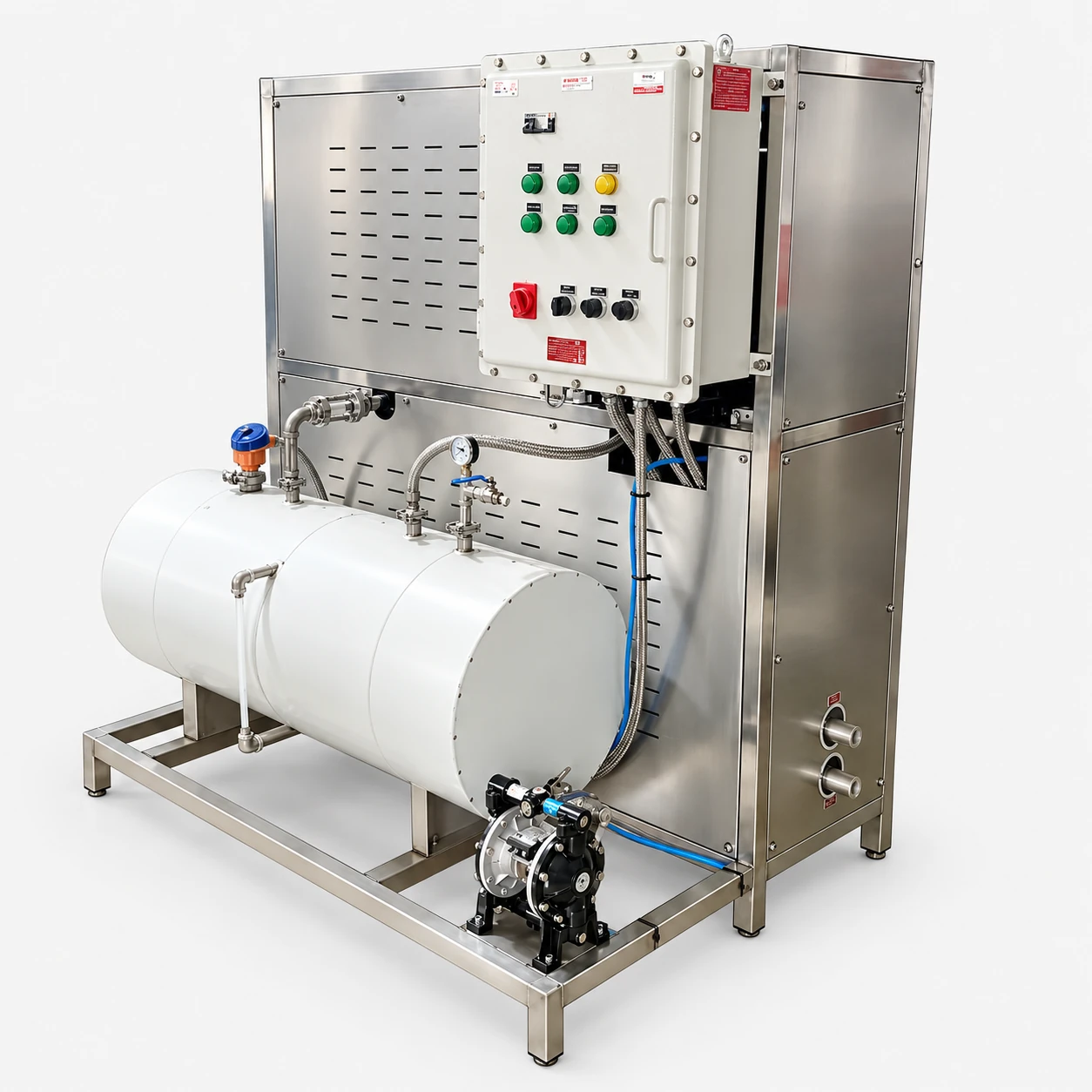
Compare VS-50, VS-100 and VS-150 by tank capacity, power and installation dimensions. Tank capacity is a storage value; assess recovery throughput separately for your solvent stream.
Confirm the vapour-feed composition, flow units and process connection for the selected configuration. Liquid output uses a diaphragm-pump arrangement. Review liquid-feed distillation requirements separately.
Review the specifications alongside your process conditions and installation requirements. The quotation should confirm the configuration, connections and required documentation.
Review the standard specifications below. Dimensions are listed as length × width × height. Confirm the final configuration and installation dimensions in the quotation and approved drawing before ordering.
| Model | VS-50 | VS-100 | VS-150 |
|---|---|---|---|
| Source model | SZ-DWH-50L | SZ-DWH-100L | SZ-DWH-150L |
| Tank capacity | 50 L | 100 L | 150 L |
| Total power | 4 kW | 8 kW | 18.5 kW |
| Reference supply | Three-phase 380 V | Three-phase 380 V | Three-phase 380 V |
| Dimensions (L × W × H), mm | 1,200 × 1,200 × 1,600 | 1,500 × 1,200 × 2,000 | 723 × 560 × 2,200 |
| Wet-vapour feed — confirm units before sizing | ≤20 L/s | ≤50 L/s | ≤80 L/s |
| Cooling system | Direct expansion | Direct expansion | Direct expansion |
Provide your site voltage and frequency so electrical compatibility can be confirmed before ordering.
Direct-expansion cooling and diaphragm-pump liquid output are part of the reference configuration. Confirm inlet conditions, connections and the recovered-liquid destination during process review.
Provide the identity and composition of the stream, expected loading, temperature and operating pattern. Include any changes between production batches.
State the intended use of the recovered liquid and the measurable quality or outlet condition required. Confirm the method used to verify the result.
Define the receiving vessel, output connection and handling procedure. Tank volume is a storage parameter and should not be substituted for a recovery-rate specification.
Provide solvent identity, composition, vapour concentration, temperature, moisture and expected loading. Confirm the recovered-liquid quality target and compatibility of the materials in contact with the stream.
For hazardous-area installations, confirm the applicable classification and required certification before ordering. Verify the vapour-feed units and operating conditions with the supplier before sizing the equipment.
Provide representative process conditions and the treatment result you need so the configuration can be assessed for your application.
The three sizes are listed in the specification table above. Select around the measured feed and required output conditions. The largest storage tank or highest airflow does not automatically provide the best result for an undefined solvent stream.
The VS line and VR line use separate model prefixes and different sizing references. VS lists storage volume and wet-vapour feed; VR lists airflow and collection-tank volume. Do not directly compare these values as if they measured the same process capacity.
Provide an installation sketch, connection positions, available floor space and service clearances. Confirm the final drawing rather than relying on the photograph alone.
State the electrical supply and operating conditions. Confirm the control interface and commissioning requirements for the quoted configuration.
Request the operating manual and maintenance instructions for the actual build. Agree the inspection routine and any site-specific requirements before commissioning.
Review the specified protection functions and settings for the selected configuration, including power-loss, circuit-fault, overtemperature and high-level protection. VS includes low-water protection; VR includes phase-loss and exhaust-overheat protection. Confirm any required certification separately.
The AI-enhanced series image illustrates a representative configuration. Confirm the selected size and delivered arrangement in the quotation and approved drawing.
Specify your site voltage and frequency. Confirm electrical compatibility and any required adaptation in the quotation.
Suitability depends on your fluid or vapour composition, contamination and operating conditions. Agree the treatment target and any required sample testing before ordering.
Provide process composition, operating temperature, expected loading, required treatment schedule, installation sketch and utilities. State the result you need so the configuration can be assessed against it.
Request a review of the proposed VS Series configuration. Include the operating conditions and a sketch of the intended connection layout so the equipment and documentation requirements can be checked together.
Request a VS Series Review