
20 L Solids Capacity
The largest solids capacity in the VC range supports heavy loading and longer intervals between automatic discharge cycles.
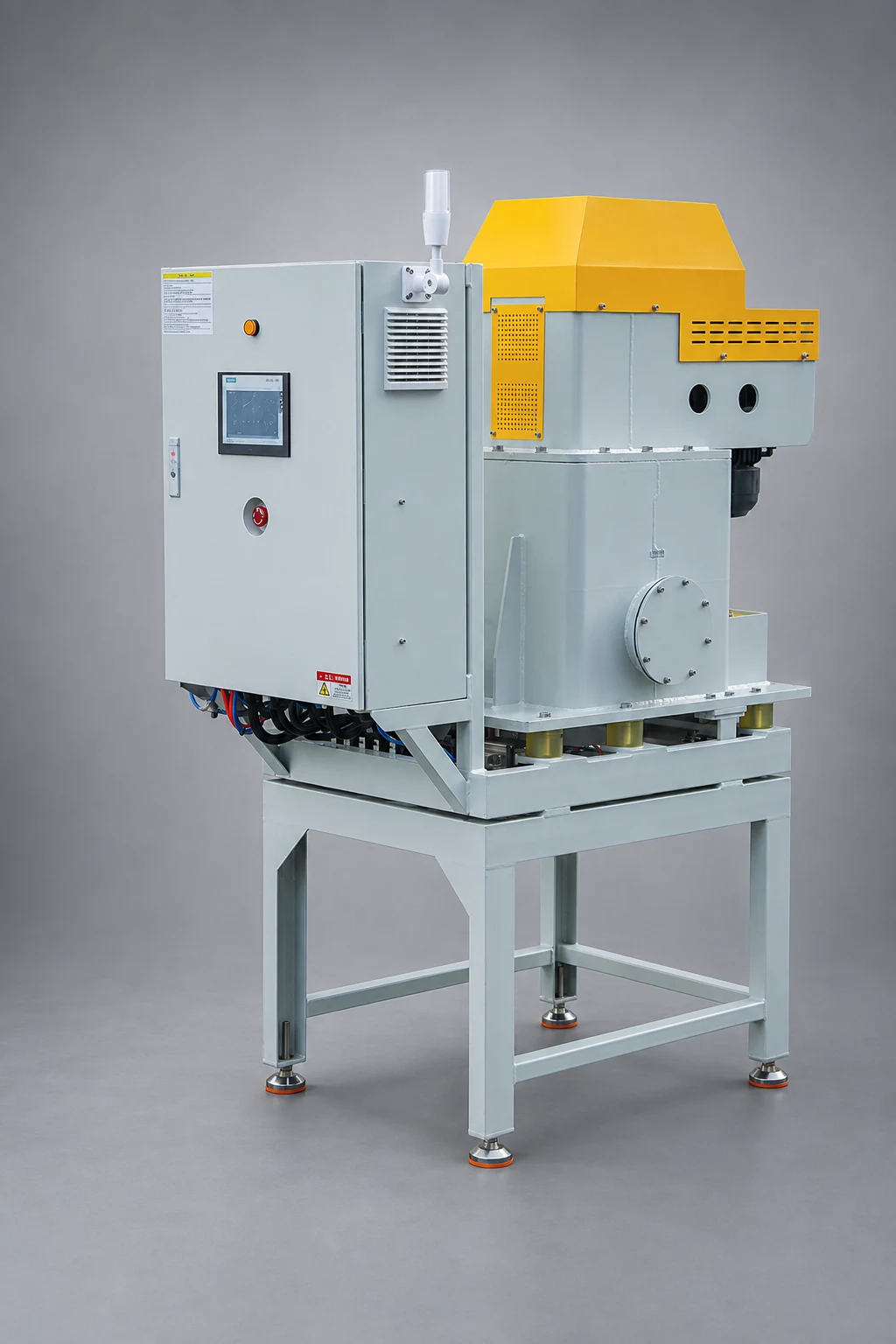
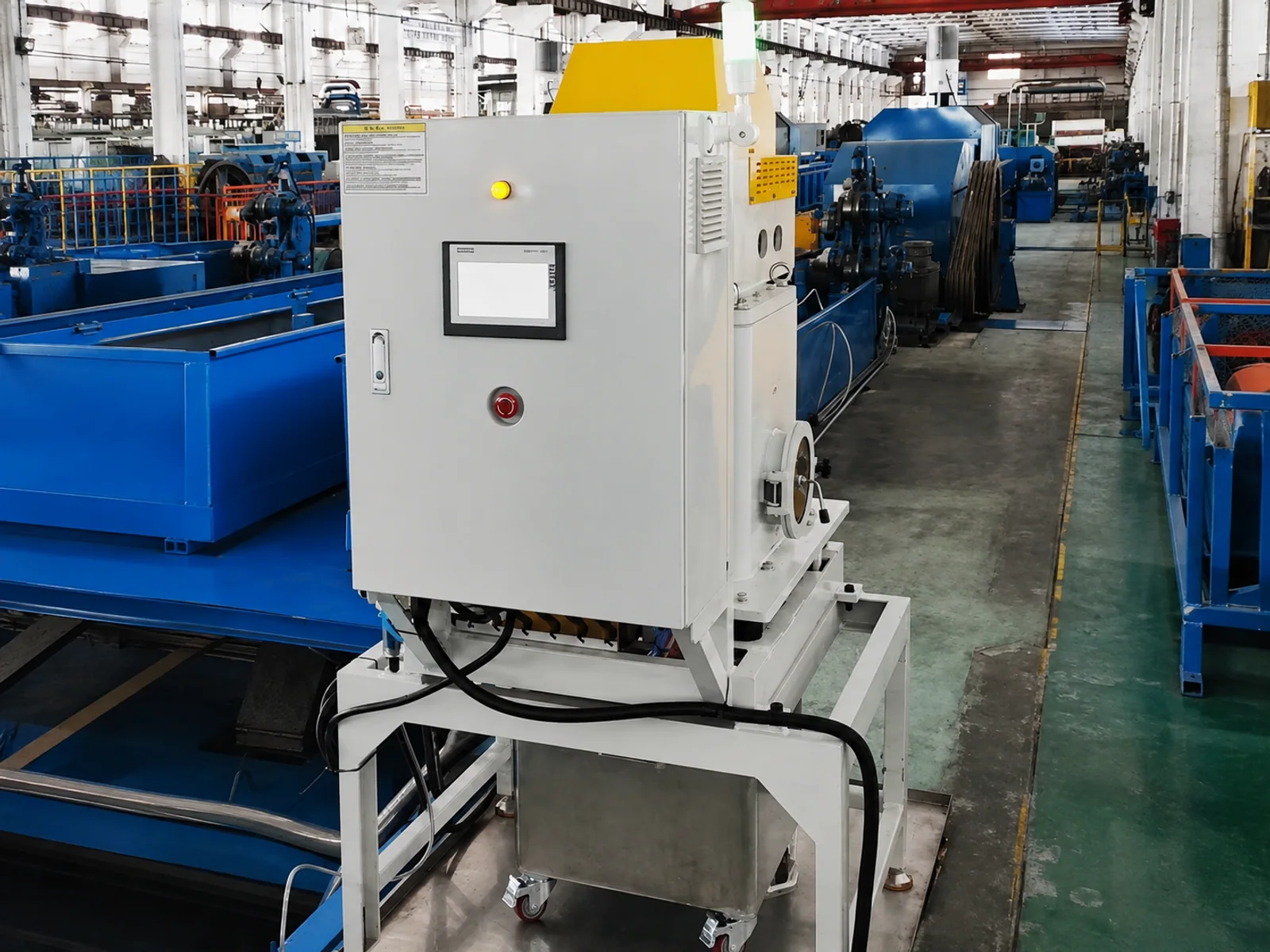
VC-2000 large capacity coolant centrifuge with 20 L solids capacity, 200 L/min rated flow and automatic sludge discharge.
No online payment. Model selection and commercial terms are confirmed for each industrial application.
The VC-2000 is the largest automatic sludge discharge coolant centrifuge in the current VC series. It combines 20 L solids capacity with a maximum rated flow of 200 L/min. The model is intended for projects where solids accumulation and discharge interval are major design constraints.
Its maximum separation force is 1,700 G at 3,000 rpm. This is lower than the smaller high-G models, so the VC-2000 should not be treated as the universal choice for the finest or most difficult particles. It is selected when process testing confirms suitable separation and the application benefits from higher flow and substantially greater solids holding capacity.
The largest solids capacity in the VC range supports heavy loading and longer intervals between automatic discharge cycles.
Designed for large circulation circuits, subject to pump, pipe, fluid and process verification.
Collected solids leave through the controlled discharge system without routine manual bowl emptying.
Process fluid is supplied from the sump to the rotating bowl. Under centrifugal force, compatible suspended solids move toward the outer collection area while the liquid phase follows the outlet path back to the production circuit. The control system initiates the discharge sequence according to the configured operating logic.
The pump and pipework deliver contaminated fluid at a controlled rate. The suction point should capture representative contamination without drawing air or excessive settled debris.
The bowl rotates at up to 3,000 rpm. Separation performance depends on density difference, particle behavior, viscosity, temperature and residence time.
The 20 L solids zone holds separated material until the automatic cycle transfers it to the designated collection arrangement.
Cleaned fluid returns to the sump for reuse. The return position should support full-circuit turnover rather than sending the same cleaned volume directly back to the suction point.
The VC-2000 removes separable suspended solids. It does not regenerate depleted fluid chemistry or guarantee a fixed particle size result without representative testing.
These values follow the approved Vimfun model reference. Site-specific pumps, piping, controls, discharge collection and electrical configuration are defined during application review.
| Specification | VC-2000 |
|---|---|
| Maximum rated flow | 200 L/min |
| Bowl speed | 3,000 rpm |
| Maximum separation force | 1,700 G |
| Solids capacity | 20 L |
| Installed power | 7.7 kW |
| Overall dimensions | 2100 × 1510 × 1075 mm |
| Machine weight | 866 kg |
| Standard electrical supply | 380V / 50Hz, three-phase |
| Optional electrical supply | 400V / 50Hz or 480V / 60Hz on request |
| Sludge handling | Automatic sludge discharge |
| Filter media | No disposable media in the centrifugal separation stage |
Allow for the 866 kg machine weight, operating access, discharge collection and safe maintenance clearance when planning the installation area.
Representative component close-ups support installation and maintenance discussions. Final connection, pneumatic and monitoring arrangements are confirmed against the delivered configuration.
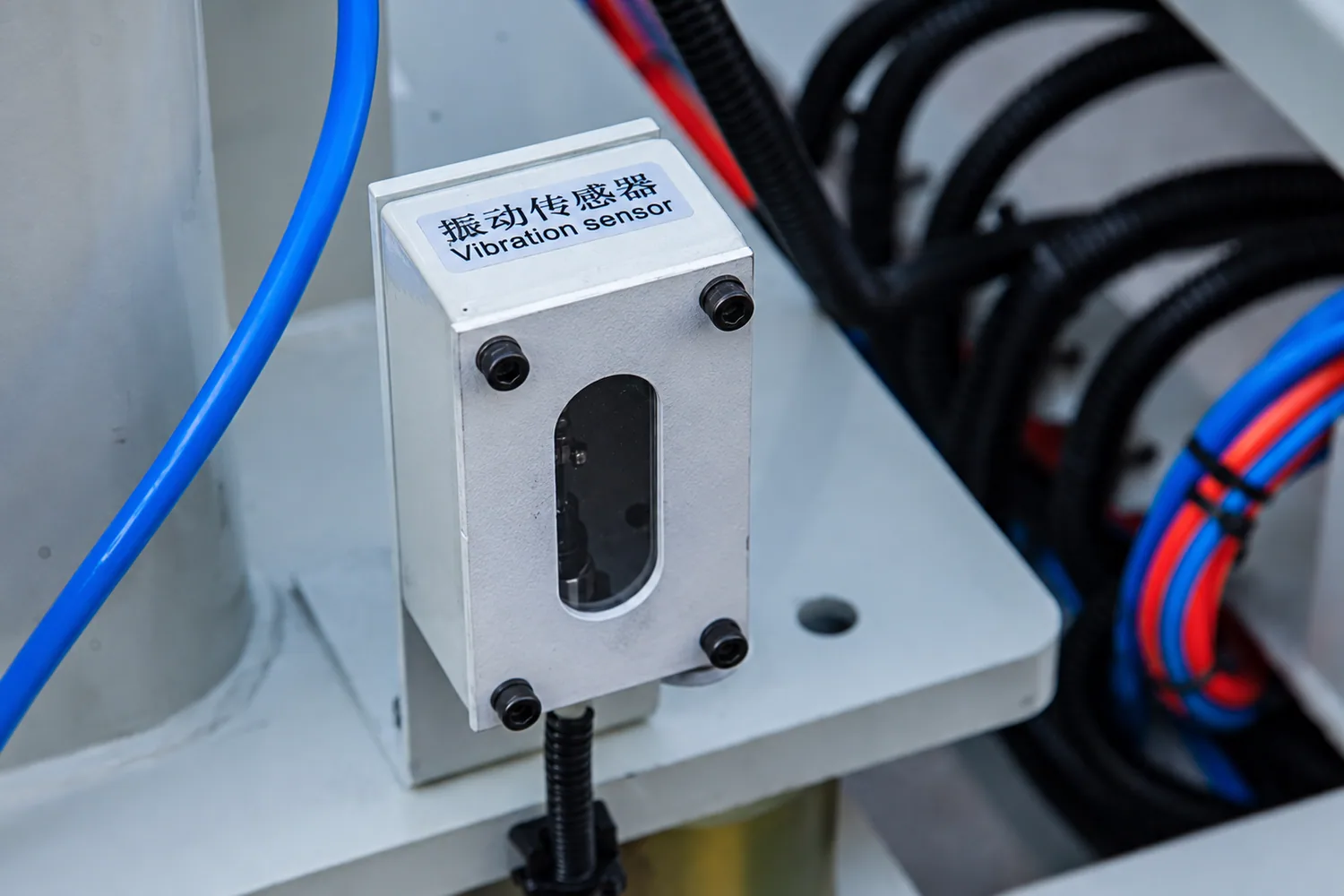
A dedicated vibration sensor provides a monitoring point for machine operating condition.
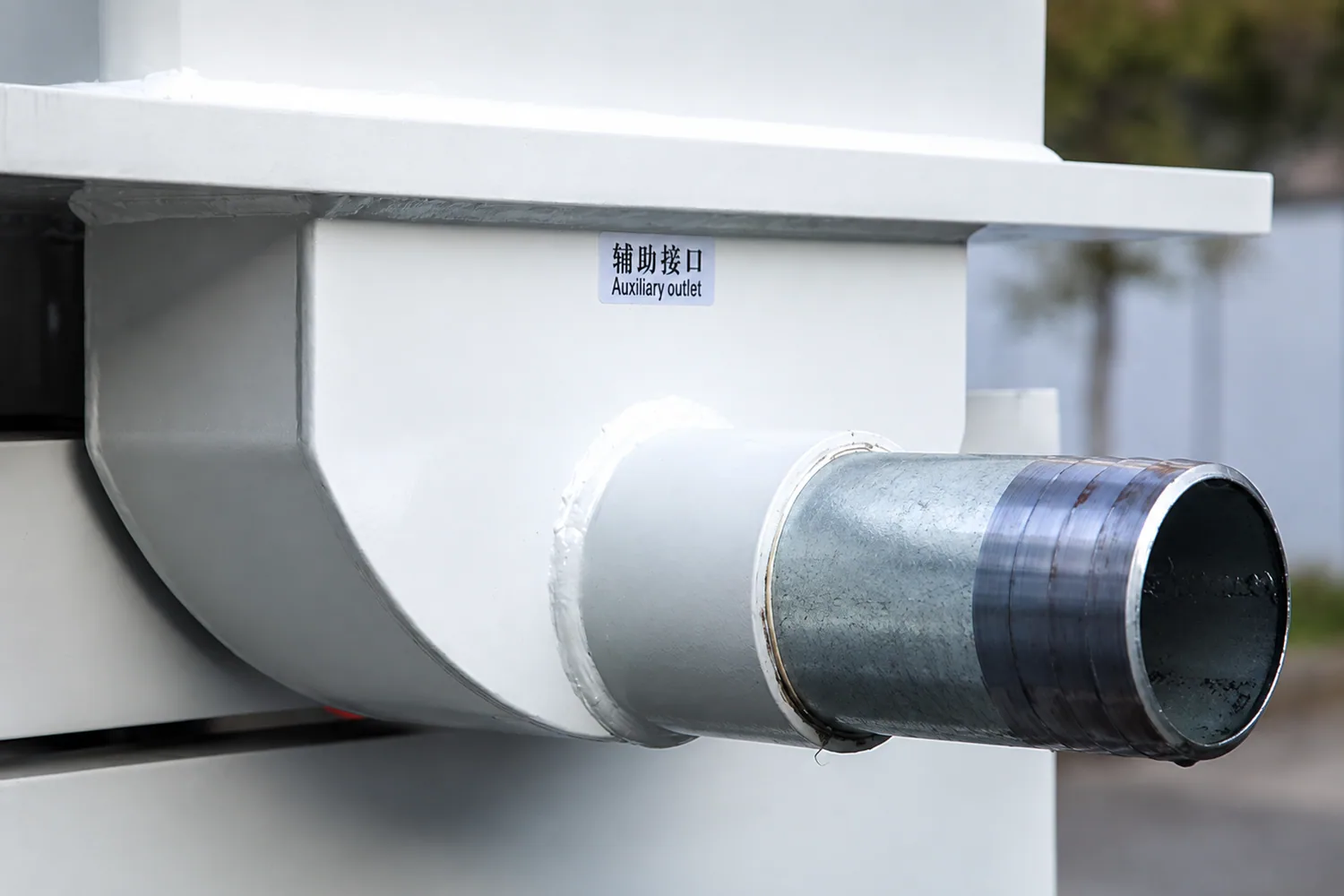
The auxiliary outlet is shown for connection and installation review. Final pipe routing is confirmed for each project.
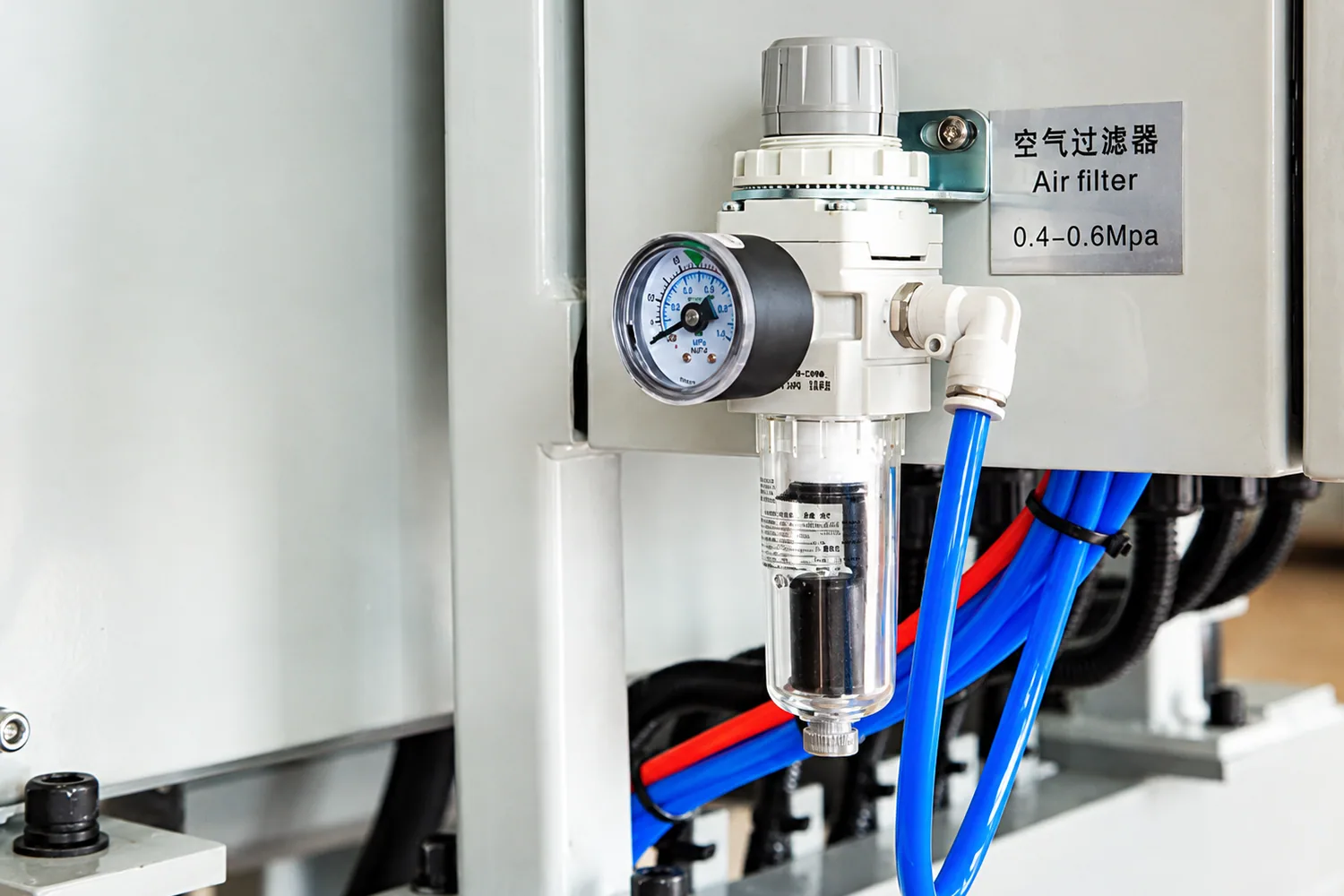
The air preparation assembly filters and regulates the pneumatic supply used by the delivered machine configuration.
The main reason to move from the VC-1500 to the VC-2000 is not simply a larger flow number. The stronger distinction is solids capacity: 20 L rather than 8 L. That difference can matter where a circuit produces enough compacted solids to force very frequent discharge cycles on a smaller unit.
Collect representative sludge data from the existing process. Separate liquid from the sample where practical and estimate the volume or mass of solids generated during a normal production period. Use this information to estimate discharge frequency rather than relying on visual fluid color.
Startup cleaning, seasonal production, tool changes and different materials can change the solids load. Size for a realistic high-load condition instead of an average that may hide short peaks.
High holding capacity has little value if the target contamination does not separate effectively at the available G force and residence time. Representative sample testing should confirm the separation behavior before final selection.
Automatic discharge transfers responsibility from manual bowl cleaning to collection and handling. The receiving container, access route and disposal or recovery procedure must match the material and operating environment.
A 200 L/min rated separator belongs in a system design, not as an isolated box beside the sump. The pump curve, total pipe length, elevation, bends, valves and return restrictions determine the actual delivered flow. Oversizing the feed can shorten residence time and reduce the result the buyer expected.
Calculate the working fluid volume and required circulation interval across all connected machines.
Confirm pressure loss and stable feed at the intended operating point rather than using free-flow pump capacity.
Return cleaned fluid where it supports mixing and full-system circulation without creating a short loop.
For multiple-machine systems, isolate equipment where necessary so maintenance on the separator or one branch does not create avoidable disruption across the entire production line. The final arrangement may include balancing, bypass or staged treatment depending on the process.
Review the coolant centrifuge sizing checklist and send a simple circuit drawing with the inquiry.
The VC-2000 is considered for large or heavily loaded circuits after the solids and sample behavior have been verified. It is not limited to one industry, and no application should be approved from the industry name alone.
Large circulating oil systems carrying separable scale or metallic fines may benefit from higher solids capacity.
Review rolling mill oil filtration →Central coolant systems serving many machines can combine high circulation demand with sustained solids generation.
Review grinding coolant filtration →Large forming operations may generate iron fines and coating residue that require frequent solids handling.
Review cold heading oil filtration →Where the priority is difficult fine-particle separation rather than capacity, a higher-G model or a different process arrangement may be more suitable. Testing should compare the actual result, not only the rated flow.
Select the VC-1500 when the project is primarily driven by higher circulation flow for several machines and its 8 L solids capacity provides a practical discharge interval. Move to the VC-2000 when representative loading shows that 20 L capacity and the larger model envelope better match the operating requirement.
| Model | Rated flow | Maximum G | Solids capacity | Primary selection direction |
|---|---|---|---|---|
| VC-600 | 60 L/min | 6,500 G | 2 L | Highest G requirement |
| VC-800 | 80 L/min | 2,800 G | 3.2 L | Balanced mid-range duty |
| VC-1500 | 150 L/min | 1,860 G | 8 L | Multiple-machine flow |
| VC-2000 | 200 L/min | 1,700 G | 20 L | High solids capacity |
The VC-2000 does not replace the VC-600 or VC-1500 by default. Each model protects a different selection priority. View the automatic sludge discharge series for the family overview.
Provide a level industrial floor, service clearance and a safe route for maintenance around the 2100 × 1510 × 1075 mm machine.
Inspect the separation area, discharge path, seals, pipework, pump and controls according to operating hours and solids loading.
380V/50Hz three-phase is standard. 400V/50Hz and 480V/60Hz options must be confirmed before order.
No disposable paper or bags are used in the centrifugal separation stage, but the process still produces collected solids. Their classification, containment, transport and disposal or recovery remain the plant's responsibility.
See centrifuge maintenance and spare parts for service planning. Final warranty, commissioning, electrical documentation and spare-parts scope are defined in the project quotation.
No. It is the maximum rated flow. Actual commissioned flow depends on the fluid, viscosity, temperature, pipe loss, pump duty, solids load and required separation result.
Choose it when measured solids generation would create impractical discharge frequency in a smaller model and testing confirms suitable separation at the VC-2000 operating range.
No. It reduces manual solids removal from the bowl. Inspection, cleaning, wear-part replacement and discharge-system maintenance are still required.
Send the fluid type, contamination, sump volume, desired turnover, solids per shift, temperature, number of machines, voltage and a sample or process drawing where available.